
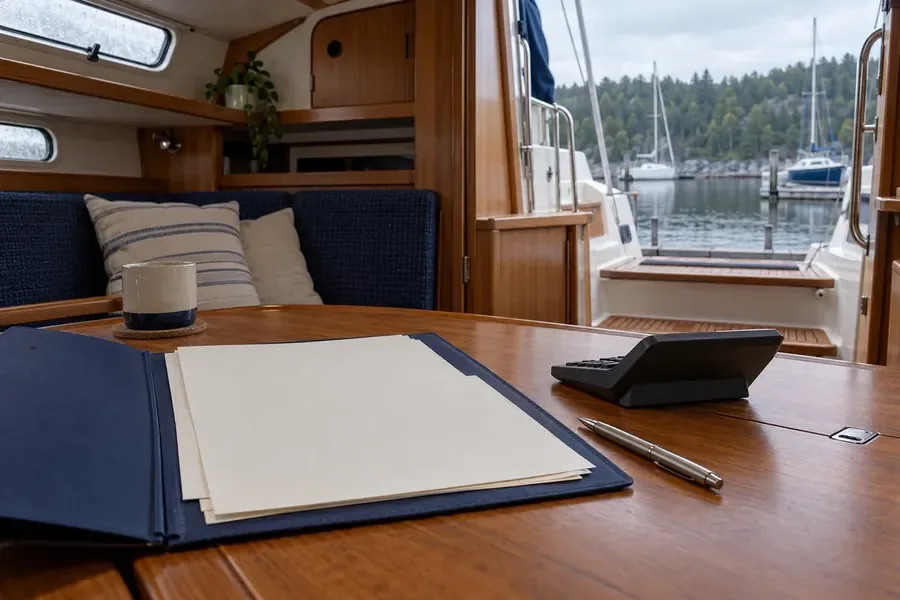
You do not finance a boat the way you finance a car. The right credit instrument depends on the amount borrowed, how the boat is recorded, who is selling it and where it will be used. For most large loans, the best security remains the marine mortgage, provided the boat is registered. Here is how our marine advisors present the choices to their clients and to the financial institutions that entrust their files to them.
This article complements our guide Buying a used boat: the checks a marine advisor makes.
1.
The marine mortgage, the best security on a boat
The marine mortgage is a Canadian federal security. It can only exist on a boat registered under the Canada Shipping Act. That is why the choice between a Pleasure Craft Licence and a Certificate of Registry, explained in our article Pleasure Craft Licence or Certificate of Registry, has a direct effect on financing.
This security takes advantage of the benefits of registration and gives the borrower attractive terms:
- very attractive interest rates and advantageous repayment terms;
- an amortization that, in some cases, can exceed 15 years;
- interest usually compounded monthly, rather than every six months;
- in most cases, the option to prepay, in whole or in part and at any time, without penalty, unless the credit instruments provide otherwise.
Whether the boat is in your name or in your business’s, the marine mortgage is the best choice as soon as you borrow $35,000 or more.
In return, the lender obtains great security. The notice period for taking possession can be very short, and the creditor can sell the boat without a court order. Most lenders use it as an umbrella security that protects all their credit products: personal loan, line of credit, demand loan, hypothecary suretyship. The loans can then be renegotiated, renewed or replaced without a new mortgage, as long as the total of the advances does not exceed the registered amount.
This flexibility has a consequence for the buyer of a used boat: except in very rare cases, the marine mortgage cannot be assumed. It can protect advances that have nothing to do with the boat and that continue to exist after the sale. The buyer must therefore never assume that they are simply taking over the seller’s loan.
2.
The other ways to finance a boat and their limits
Other credit instruments exist. They have their place, but also their limits.
The personal loan or the line of credit. These loans do not directly encumber the boat, unless they are secured by a movable hypothec or a marine mortgage. Their rates are usually quite high and the repayment period rarely exceeds five years. They are suggested mainly for advances of less than $35,000. They often remain after the boat is sold.
The movable hypothec. It is registered under the laws of a province: the RDPRM in Quebec, the PPSA in Ontario and in other provinces. Because it falls under a single province, it is less secure for the lender, especially if the boat is used outside the country. Its rates and terms are less flexible. Note: a hypothec registered with the RDPRM on a boat already registered in Canada or in another country has no value as security.
The instalment or conditional sale contract. This contract, designed for goods such as furniture and cars, is used for boats of lower value that do not regularly travel in foreign waters. The lender remains the owner until the last payment. Its limits are significant: an interest cost that is usually high, advances that cannot be transferred to a subsequent buyer, and the exclusion of boats kept in bond, boats bought outside Canada and private sales. The seller must be a Canadian dealer, the boat must not be registered and the sales taxes must have been paid in full.
The immovable hypothec. It most often encumbers the family residence and involves high notarial fees.
One practical point applies to all these cases: if your offer to purchase depends on obtaining a loan, that condition must be written into the offer. If the loan is refused, the seller can require a letter from the lender confirming it; without that letter, the buyer risks losing their deposit. Our marine note Selling price, payment and holdback details the clauses of an offer.
3.
Interim financing: benefiting from the marine mortgage from the time of purchase
It takes time to register a boat and to register a marine mortgage. Interim financing allows the lender to give its client the terms of the marine mortgage from the time of purchase, before the security is taken. It is a temporary situation rather than a form of financing in itself, and many Canadian owners take advantage of it, in Canada as well as abroad.
The file follows precise rules:
- a marine advisor manages the file and handles the registration and the mortgage personally, not the borrower;
- the buyer signs a mortgage commitment agreement that expires in 90 days;
- all the registration and mortgage documents are signed in advance and remain in the hands of the marine advisor;
- proof of adequate insurance is issued, not a mere undertaking to obtain insurance;
- the lender pays the seller directly once these conditions are met;
- the Certificate of Registry is issued after the boat has been paid in full, then handed to the marine advisor, who immediately registers the mortgage.
The rules vary depending on the seller. When it is a Canadian dealer, the buyer signs an instalment sale contract and an ownership agreement: upon registration, the lender gives up its ownership and becomes a first-ranking mortgage creditor. When it is a private individual or a seller from another country, a favourable investigation must first be made into the seller and into the boat, and the buyer can sign any credit instrument except an instalment sale contract.
Thanks to the large number of marine files we manage for financial institutions, we can also direct you, at no charge, to the branch best able to serve you well.
4.
After the loan: do not forget the discharge
Financing ends with the discharge, a step that is often neglected. Discharges must be registered and the reports completed as soon as possible, for movable hypothecs as well as marine mortgages. Otherwise, it will have to be dealt with at resale, which can cause unwanted delays.
The two security interests are not removed in the same way. Some provincial systems have a set registration period: in Quebec, it ranges from 1 to 10 years depending on the lender’s request, and the security is struck off automatically at the end. The marine mortgage, on the other hand, is permanent: it is only struck off after certain documents are presented to the Canadian authorities or on the order of a competent court. The marine advisor prepares the documents, obtains the signatures, submits the file, obtains a search certificate confirming the discharge, then sends the reports to the debtor, to their lender and, where applicable, to the new buyer and their lender.
To choose the right financing and prepare the right documents, write to one of our marine advisors or call us at (514) 985-6606. Our Marine credit page also covers marine mortgages and discharges.
Related reading
Firm service
Marine note

Marine note
The ten notes
Blog article
Talk to a marine advisor
Give yourself the best chance: call us!
- Telephone: (514) 985-6606
- Toll-free, Canada and United States: (866) 531-2645
- Write to the office


