
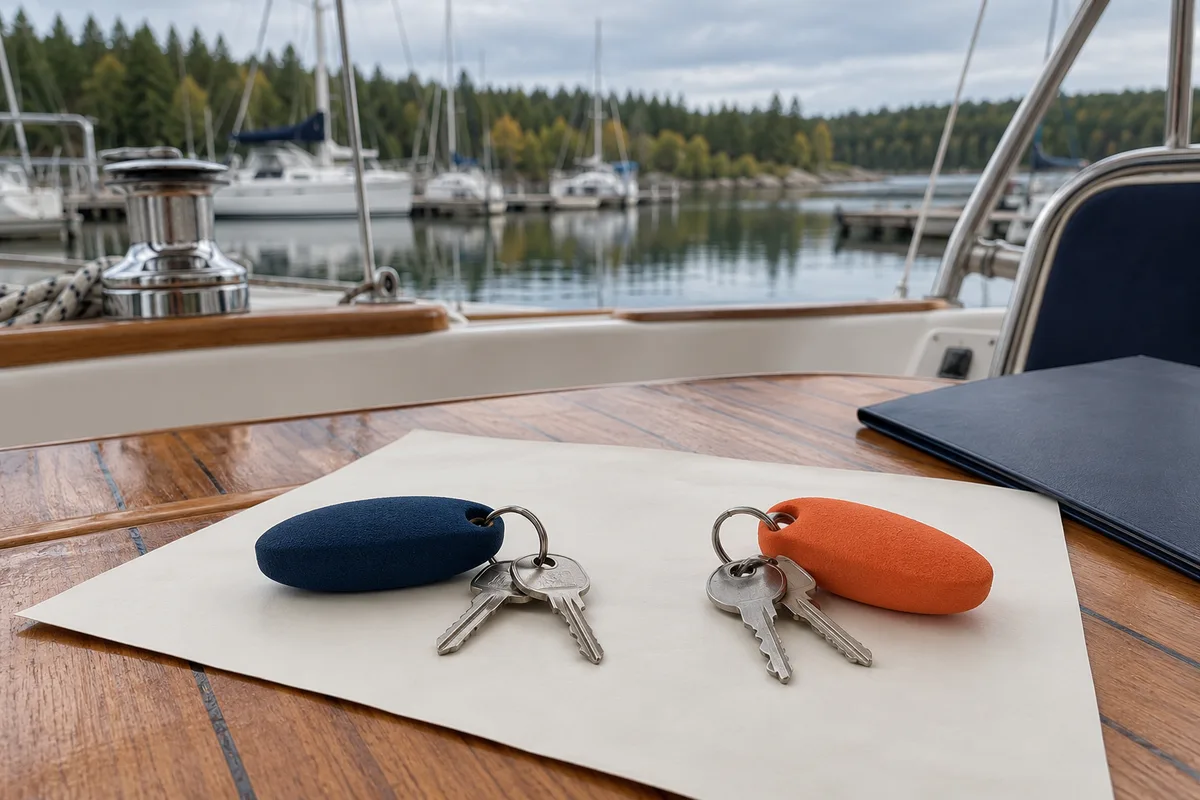
Single owner or with other persons
When a boat is or will be owned by more than one person, the property sharing decision may have an important impact upon a resale, a division of ownership or a death. Documents to be signed in order to formalize the registration will take this decision into account.
Registration is explained in more detail in Marine note No. 3, Registration, Canada and other countries.
Shares
A registered vessel is somewhat like a company and is divided into 64 shares that may be the property of one or more persons or corporations.
Ownership
Each share or each group of shares may be owned by a maximum of 5 persons. The theoretical maximum number of owners involved in the ownership of a boat is then 5 times 64 giving 320 persons. Usually when more than 4 people wish to own a registered vessel, it is suggested that they incorporate a company.
If only a single person owns the 64 shares, he is sole owner of the entire boat.
Joint owners
Ownership in common by several persons of a specific number of shares. Two or more persons can have ownership.
Example: a couple and their sister-in-law together own a boat, so they together own all the 64 shares of the vessel.
Sale
At the time of sale, the payment from the buyer to the seller will be payable jointly to the three selling owners
Marine mortgage
Ex.: the couple and the sister-in-law, together, borrow from the bank an amount of $50,000.00
- The bank prepares one loan agreement for $50,000.00
- All three (3) parties sign the loan document
Each one of these persons is jointly and severally liable for the repayment of the total amount of $50,000.00
- The bank records show only one mortgage signed by the three persons
Death
Should one of the joint owners die, his estate does not inherit the boat. The surviving joint owners remain the only owners of the shares they owned with the deceased. This is called the “Right of Survivorship”.
And so on up to the last owner's death, for whom the usual succession process applies. The “Right of Survivorship” applies till all owners have passed away.
Co-owners
The boat is owned by blocks of person(s). Each block of person(s) owns a number of shares smaller than 64. The total of the shares owned by all the blocks equals 64. The number of shares owned must be an integer number of shares (fractional shares are not accepted).
Ex.:
| Block | Owner(s) | Shares |
|---|---|---|
| A | Peter | 30 |
| B | John | 10 |
| C | James and his child (of legal age) | 24 |
| Grand total | 64 |
Sale
Each block of person(s) may sell part or all of the shares it owns, and get the amount of money representing “its own sale”. It is not necessary to sell the whole boat.
- Block A: Peter may sell part or all of his 30 shares for $1,000.00, at his own option
- Block B: John may sell part or all of his 10 shares for $25,000.00, at his own option
- Block C: James and his child must sign, together, for the sale of part or all of their shares for a price at their own option
Should the “whole” boat be sold, each block of seller(s) will get the part of the selling price proportional to its number of shares for a total of 64.
Marine mortgage
Ex.: The bank lends an amount of $100,000.00
- The bank prepares a loan contract for $100,000.00
- The four (4) persons sign the loan contract.
- Each one of the four persons is jointly and severally liable for the repayment of the total amount of $100,000.00
A financial institution will always take the full boat as security. There will be as many mortgages as there are blocks of owners. A block may give only what it owns as security.
The bank files three (3) mortgages of $100,000.00 each:
- a) Mortgage for block A, signed by Peter
- b) Mortgage for block B, signed by John
- c) Mortgage for block C, signed by James and his child
Death
Example:
If Peter dies, the usual death procedures apply.
If John dies, the usual death procedures apply.
- If James or his child dies, the survivor becomes the sole owner of the 24 shares both owned together.
This article is a short summary of some of the topics to consider in relation to a vessel purchase, sale or financing.
Each transaction is a special case.
Talk to a marine advisor
Give yourself every chance: call us!
- Telephone: (514) 985-6606
- Toll free, Canada and United States: (866) 531-2645
- Write to the office


