
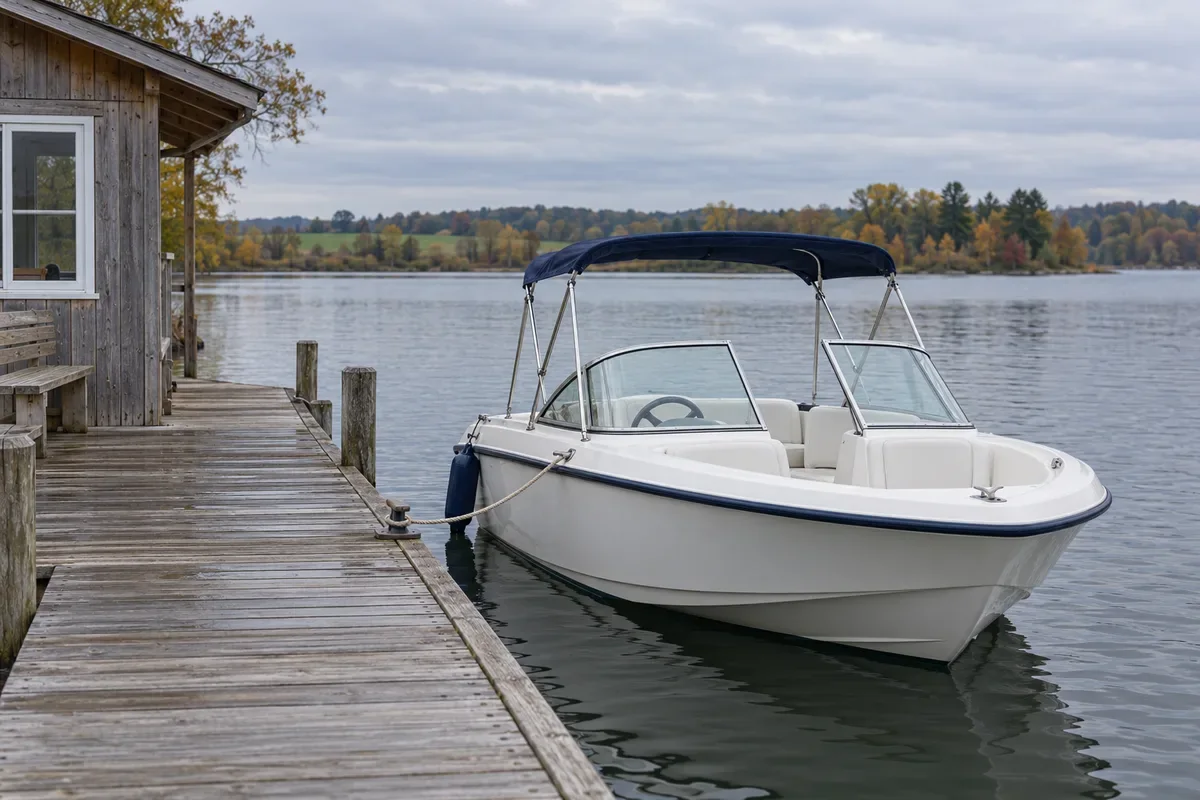
For several years now, a large number of the used boats bought by Canadians have come from the United States. The price can be attractive, but the transaction involves the tax, customs and registration rules of two countries. A mistake can be costly: a boat that was not imported properly can be checked at any time for non-payment of taxes. Here are the points our marine advisors check with their clients before a purchase on the other side of the border.
This article complements our guide Buying a used boat: the checks a marine advisor makes.
1.
Buying outside Canada: when Canadian taxes apply
The basic rule is simple: a boat bought in another country that is not used in Canada is subject to no Canadian sales tax and no Canadian customs duty. It is the boat’s arrival in Canada that triggers its importation.
A few principles follow from this:
- the local sales taxes of the place where the boat is located at the time of purchase are payable, with some exceptions;
- sales taxes paid to a foreign government are not credited in Canada;
- if the boat is later used in Canada, it will have to be imported, and the taxes will be calculated on its value at that time, not on its value at the time of purchase.
The boat’s foreign registration does not always follow the buyer. Some foreign registrations cannot be transferred to a Canadian buyer: this is the case with the United States “Certificate of Documentation.” If the registration can be transferred and the buyer wants it in their name, they will have to pay the local sales taxes.
A Canadian who sails under a foreign registration also arouses suspicion. Canada is known everywhere for its agreements and cooperation with other countries: other countries know that a Canadian can own a boat registered in Canada and sail anywhere without paying Canadian taxes as long as the boat is not used in Canada. A Delaware registration, for example, will lead to many questions from customs officers, and to an investigation of the owning company if the boat is in its name. For a boat kept outside Canada, the only Canadian form of recording possible is the Certificate of Registry, explained in our article Pleasure Craft Licence or Certificate of Registry.
2.
Importing the boat: customs duties and sales taxes
When the boat enters Canada to be used freely there, two amounts apply: customs duties, according to the boat’s origin, and sales taxes.
Customs duties. Under CUSMA (the Canada-United States-Mexico Agreement, which replaced NAFTA in 2020), a boat built in a member country, Canada, the United States or Mexico, with materials from those countries, is exempt from customs duties. To import it duty-free, you need a certification of origin under CUSMA, which the builder, the exporter or the importer can complete. If your seller cannot help you obtain it and it is requested, you might have to pay unexpected customs duties. The reverse case also exists: an American buyer sometimes has to pay American duties on a boat built in Canada by a small builder that has closed its doors, because the certificate of origin is no longer available.
Pleasure boats built outside the CUSMA countries are subject to duties, which our marine note puts at 9.5% on importation into Canada and at 1.5% plus certain fees on importation into the United States. The place of construction matters more than the brand: our marine note gives the example of Bénéteau boats built at the plant in Marion, South Carolina, which are exempt from duties, while those from their plants in France are not.
Sales taxes. In addition to customs duties, the GST and the provincial sales tax of the buyer’s province are payable. In Quebec, property bought outside the province and brought in to be used there is subject to the Quebec sales tax: the buyer must declare it and self-assess the tax.
These rules also affect the boat’s title. Several used boats bought in the United States and recorded in Canada with a Pleasure Craft Licence were not in order, because the import taxes had not been paid. A Pleasure Craft Licence is only issued for a boat mainly used and maintained in Canada, and only after importation. Our article Debts on a used boat: check the title before you pay explains this risk.
3.
Keeping the boat in the United States: in bond and temporary importation
Many Canadians keep their boat outside the country: on Lake Champlain, in Florida, in the Caribbean. A boat owned by a Canadian on which the Canadian taxes and duties have not been paid is said to be “duty-free” or “in bond.” This status is legal, but the boat may not be used freely in Canada.
State taxes. Keeping the boat in the United States carries some risk of being assessed by the state where it is located. Some states consider that a foreign boat present in their waters for more than 30 days, whose owner has not paid the sales tax in their own country, must pay a use tax, at the same rate as their sales tax. Other states follow these matters less closely. Each state has its own rules, and our marine note Taxes and duty fees describes those of the states most popular with Canadians, such as Maryland, New York, Vermont and Florida.
Temporary importation into Canada. A boat in bond can enter Canada, but only to be maintained, repaired or modified, and under very strict rules:
- an application for temporary importation, form E29B, must be approved before entry, with an estimate from the repairer;
- the boat must go directly to the repairer, without any detour;
- if it enters in the spring or summer, it must leave on the date set according to the repairs; if it enters in the fall or winter, it can be repaired over the winter, but must have left the country by June 15 of the following year at the latest;
- it cannot be sold or rented without the taxes being paid or the authorities being officially notified of the sale before it leaves.
Failing to follow any of these rules can lead to the seizure of the boat, the mandatory payment of the taxes and duties owed and a heavy fine.
4.
Sailing in the United States with a Canadian boat
To make sailing in the United States easier, the American authorities issue a “Cruising License.” It is valid for one year; to renew it, the boat must leave American territory, come back and apply for a new document. Its cost is very low, and our advisors strongly recommend obtaining it.
In Florida, for example, our marine note explains that a boat registered in a foreign country, such as Canada, can stay there without being subject to the state sales tax if its Cruising License is in order and the required formalities are completed on time. These formalities are precise and the deadlines are short: it is better to check them before the purchase.
Every international transaction is a special case. Before making an offer on a boat in the United States or in the Caribbean, write to one of our marine advisors or call us toll-free at (866) 531-2645. We also check boat titles in Canada, the United States, the Caribbean and Europe.
Related reading
Marine note
Firm service
Marine note
The ten notes
Blog article
Talk to a marine advisor
Give yourself the best chance: call us!
- Telephone: (514) 985-6606
- Toll-free, Canada and United States: (866) 531-2645
- Write to the office


