
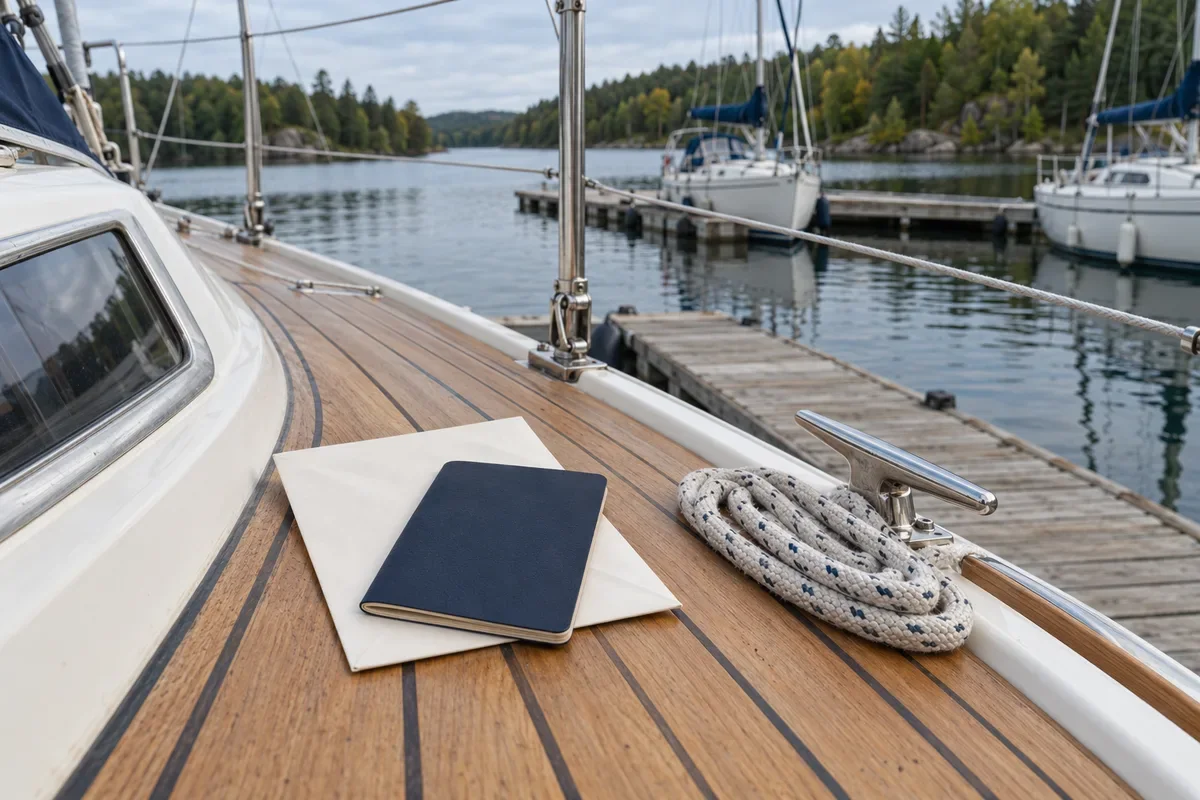
Many Canadians keep their boat outside the country: on Lake Champlain, in Florida, in the Caribbean. As long as it is not used in Canada, such a boat does not have to pay Canadian sales taxes or customs duties. It is said to be “duty-free” or “in bond.” This status is legal, but it comes with strict rules, especially on the day the boat has to come back to Canada to be repaired.
This article is part of our guide Buying a used boat: the checks a marine advisor makes.
1.
What is a duty-free boat?
A boat owned by a Canadian, on which the sales taxes and customs duties have not been paid in Canada, is a duty-free boat. It may have been built in Canada or anywhere else.
Two situations lead to this status:
- a boat delivered by a dealer or by a transport company to a place outside Canada has no Canadian sales tax to pay;
- a boat bought outside Canada that is not used here is also exempt from Canadian taxes.
The taxes only become payable on the day the boat is used freely in Canada, that is, when it is imported. They are then calculated on the value of the boat at that time, not on its purchase price. All boat imports are subject to them, unless the law provides an exemption, whether the seller was a private individual or a business. Even a boat built in Canada and kept in bond must pay the sales taxes to be used freely here.
A duty-free boat has only one possible Canadian form of recording: the Certificate of Registry. The “B” Pleasure Craft Licence, once issued for these boats, has not been issued since October 8, 1990. Our article Pleasure Craft Licence or Certificate of Registry explains the difference.
2.
Temporary importation: coming to Canada for a repair
The only acceptable reason to bring a duty-free boat into Canada is to repair it, restore it or modify it. Customs officers then admit it temporarily, based on the documents presented to them: the Certificate of Registry as proof of ownership, and an estimate from the repairer. The process is usually started by a Canadian dealer; most of those near the American border are familiar with this kind of transaction.
The authorization, called the “Temporary Admission Permit” (form E29B), is issued free of charge. Its conditions are precise:
- the application must be approved before the boat enters the country, with the repairer’s estimate; an exemption is possible, at no cost;
- the boat must go directly to the repairer, without any detour;
- if it enters in the spring or summer, the boat must cross the border again no later than the deadline set according to the repairs;
- if it enters in the fall or winter, it can be repaired over the winter, but must not be used during that period and must have left the country by June 15 of the following year at the latest. The repairer and the owner are responsible for this;
- it cannot be sold or rented without the taxes being paid, or without the authorities being officially notified of the sale before it leaves.
Customs officers regularly check that the boat really is at the repairer’s. Failing to follow any of these rules can lead to the seizure of the boat, the mandatory payment of the taxes and duties owed and a heavy fine.
3.
Selling or keeping a duty-free boat
The sale
Selling a duty-free boat requires particular attention. A boat admitted temporarily cannot be sold without the applicable taxes being paid, or without the authorities being officially notified of the sale before it leaves. To spare the buyer from paying taxes and duties they do not expect, the boat must be physically outside the country while the sale is registered.
Customs duties, for their part, depend on the place of construction. Under CUSMA (the Canada-United States-Mexico Agreement, which replaced NAFTA in 2020), a boat built in Canada, the United States or Mexico, with materials from those countries, is exempt from customs duties; only the usual sales taxes apply to its importation. Our article Buying a boat in the United States: taxes, customs and registration explains these rules.
The boat kept in the United States
Keeping a duty-free boat in the United States carries some risk of being assessed by the state where it is located. Some states consider that a foreign boat present in their waters for more than 30 days, whose owner has not paid the sales tax in their own country, must pay a use tax, the “Users Tax,” at the same rate as their local sales tax. The amounts nevertheless remain much lower than what is required in Canada.
Other states follow these matters less closely. Florida, which relies largely on tourism, has laws that encourage foreigners to keep their boat there: if they are followed to the letter, there is no problem. Our marine note Taxes and duty fees describes the rules of Florida, New York and Vermont.
To stay clear of problems and delays, consult one of our marine advisors when buying or selling a duty-free boat, and for its Certificate of Registry. Write to us or call us toll-free at (866) 531-2645.
4.
Sources
- Hébert & Associés Conseillers Maritimes inc., Register a boat page, Duty-free boats section, Marine note no. 10, Taxes and duty fees, and Cautionary tale no. 10.
- Forms, deadlines and the rules of American states change: always check the conditions in force before a transaction.
Related reading
Marine note
Firm service
The ten notes
Talk to a marine advisor
Give yourself the best chance: call us!
- Telephone: (514) 985-6606
- Toll-free, Canada and United States: (866) 531-2645
- Write to the office


