
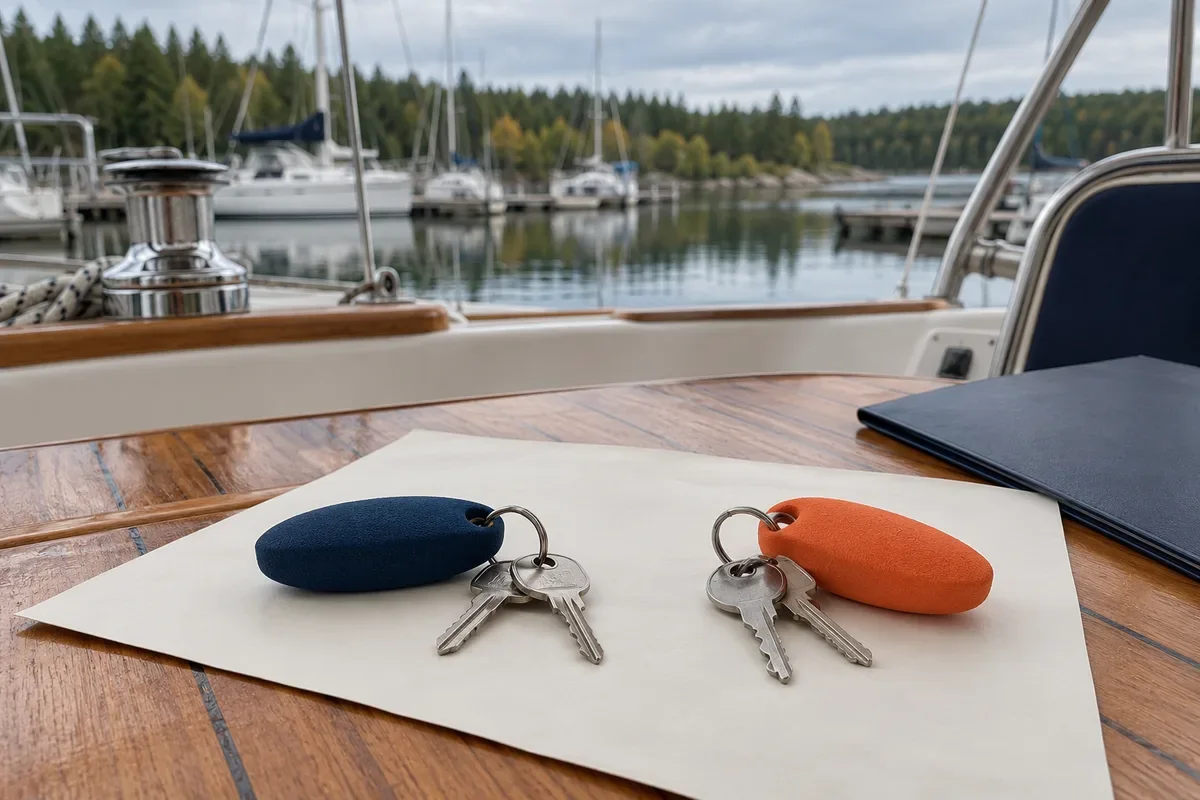
Buying a boat as a couple, as a family or with friends is common. But when a boat is registered, the way its ownership is shared is decided at the time of registration or purchase, and it has important effects later: at resale, on a partition, when borrowing or upon a death. The terms used, such as joint owners and the right of survivorship, come from English law, since the main maritime rules of Canada and the United States come from England. Here is how our marine advisors explain these choices.
This article expands on one step of our guide Buying a used boat: the checks a marine advisor makes.
1.
A registered boat is divided into 64 shares
A registered boat is a little like a company. It is divided into 64 undivided shares, which can belong to one or more natural or legal persons. A person who owns the 64 shares owns the whole boat.
Each share, or each group of shares, can be owned by 5 persons at most. In theory, a boat can therefore have up to 320 owners, that is, 5 times 64. In practice, when more than four persons want to own a registered boat, it is suggested that they form a company, which will become its owner. The number of shareholders of a company can be set in its charter.
A registered business name cannot own a registered boat, unless it belongs to a company. Our article Pleasure Craft Licence or Certificate of Registry explains the rest of the vessel’s legal status.
There are three ways to own these shares: alone, as joint owners or as co-owners.
| Sole owner | Joint ownership (“joint owners”) | Co-ownership (“co-owners”) | |
|---|---|---|---|
| Shares | The 64 shares | A number of shares owned in common | A defined number of shares per block, for a total of 64 |
| Sale | The owner sells | Payment is made jointly to all the sellers | Each block can sell some or all of its shares |
| Marine mortgage | One mortgage | A single mortgage, signed by all | One mortgage per block |
| Death | The usual settlement of the estate | Right of survivorship: the survivors keep the shares | The usual settlement of the estate for the deceased’s shares |
2.
Joint owners or co-owners
The two forms of ownership by several persons do not follow the same rules for sale, borrowing and death.
Joint ownership and the right of survivorship
In joint ownership, several persons together own a specific number of shares. For example, a husband, his wife and their sister-in-law together own the 64 shares of the boat.
The sale. When the boat is sold, the buyer’s payment is made jointly to the three selling owners.
Borrowing. If the three borrow $50,000 together, the bank prepares a $50,000 loan contract that all three sign. Each is jointly and severally liable for repaying the total amount. The bank registers a single marine mortgage, signed by the three persons.
Death. This is where joint ownership makes all the difference. When one of the joint owners dies, their estate does not inherit their shares in the boat. The surviving joint owners remain the sole owners of the shares they shared with the deceased, and so on until the last survivor. This is the “right of survivorship,” a notion close to the “joint tenancy” used in most Commonwealth countries. The survivors can dispose of their shares without delay, without waiting for the estate to be settled.
Co-ownership: blocks of shares
In co-ownership, blocks of persons each own a defined number of shares, smaller than 64. The total must equal 64, and each block owns a whole number of shares: there are no fractional shares. Our marine note gives this example:
- block A: Pierre owns 30 shares;
- block B: Jean owns 10 shares;
- block C: Jacques and his adult child together own 24 shares.
The sale. Each block can sell some or all of its shares, at the price of its choice, and receive the amount of its own sale. The boat does not have to be sold as a whole. Pierre can sell his 30 shares for $1,000 and Jean his 10 shares for $25,000, each as he chooses. Jacques and his child must sign together to sell the shares of their block. If the boat is sold as a whole, each block receives the part of the price that matches its shares out of 64.
Borrowing. A financial institution always takes the whole boat as security. Yet a block can only give as security what it owns. If the bank lends $100,000 to the four persons, who all sign the loan contract and are jointly and severally liable for it, it registers three mortgages of $100,000: one for block A, signed by Pierre, one for block B, signed by Jean, and one for block C, signed by Jacques and his child. Our Marine credit page presents the marine mortgage.
Death. If Pierre or Jean dies, the usual settlement of the estate applies to his shares. If Jacques or his child dies, the survivor becomes the sole owner of the 24 shares of their block: within a block, the right of survivorship applies.
3.
A real case: the title that had not been corrected
In a file handled by our office, a husband and wife were joint owners of a boat. The husband died following a workplace accident, and the steps to correct the registration of the title were delayed. His estate was put into bankruptcy, the boat was seized and stored, and the creditors claimed half of the boat.
Everything was settled in the widow’s favour, but the discussions were long, difficult and costly. If the title had been corrected properly, at the right time, she would have been in a much better position from the start.
Another of our files shows the opposite risk, with a boat that had only a Pleasure Craft Licence: two names appeared on the licence, one of the owners had died three years earlier, and the buyer had already paid the survivor. The will had to be found, then the three administrators of the estate, before the licence could be transferred. These two cases are told in our Cautionary tales.
4.
Planning ownership well from the time of purchase
The documents that establish whether several persons will be joint owners or co-owners are prepared at the time of registration, or when buying a boat that is already registered. The right documents must be prepared and the transaction must follow the rules. A few questions to ask yourself before signing:
- How many persons will be owners, and would it be better to form a company?
- In the event of a death, do you want the survivors to keep the boat, or the shares to follow each person’s estate?
- Should each person be able to sell their shares without the others?
- Will the boat be financed, and how many mortgages will need to be registered?
In a will, a mention of the boat is often welcome, but some clauses can complicate the survivors’ lives: it is worth thinking about them before drafting them. And once the transaction is made, do not delay in making it official.
Our marine note Ownership of a registered vessel covers these examples. To plan the ownership of your boat, write to one of our marine advisors or call us at (514) 985-6606.
Related reading
Marine note
Marine note
Firm service

Firm resource
Blog article
Talk to a marine advisor
Give yourself the best chance: call us!
- Telephone: (514) 985-6606
- Toll-free, Canada and United States: (866) 531-2645
- Write to the office


