
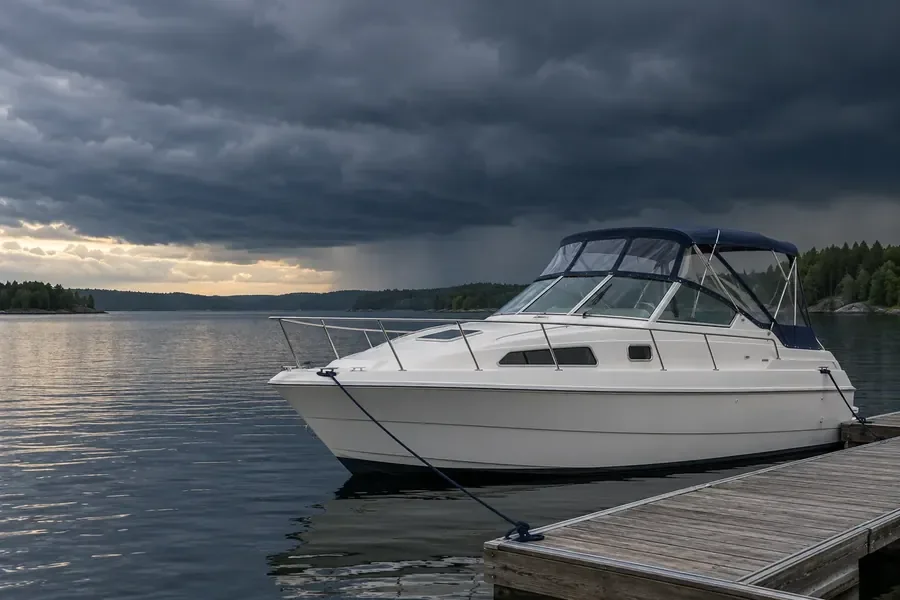
Many buyers think that only one obstacle can block the purchase of a used boat: a bank loan secured by the seller’s boat. That matters, but you often need to look more closely. A boat can be encumbered by several other debts and rights, and the seller does not always have the capacity to sell it alone. These checks are made before you pay, because afterwards it is often too late.
This article expands on one step of our guide Buying a used boat: the checks a marine advisor makes.
1.
Does the seller really have the right to sell?
The first question is about the person selling. The seller may be a natural person, a company or another legal entity, such as a registered name or a family trust. If the boat is already registered, only natural persons and companies are acceptable. The persons who sign for a company must present a resolution proving that they are authorized to sell.
A signature has no value if the signatory is a minor, signs under threat or lacks the mental capacity. It is prudent for both parties to receive a copy of the contract of sale or the offer to purchase at least 24 hours before signing.
The seller’s family situation also matters. Our advisors handled the file of a Caisse populaire that was financing the purchase of a $100,000 boat between private individuals. The seller had paid cash, the boat seemed debt-free and the survey revealed no problem. A search nevertheless showed that the seller had been divorced for four years. The divorce judgment provided that if the boat was sold, $30,000 had to be paid to his ex-wife. The file ended well, because the Caisse itself paid that amount to her after the signing. Without this check, the buyer and their lender could have faced a claim. This case is told in detail in our Cautionary tales.
2.
The main debts that can encumber a boat
Several types of debts and security interests can follow a boat, even when the seller says it is “free of debt.”
The personal loan or the line of credit. These loans do not directly encumber the boat. But the lender can later register a security on the boat to protect itself better. For a small amount and an unregistered boat, this security will be a movable hypothec, registered under provincial law: the RDPRM in Quebec, the PPSA in Ontario and in some other provinces. For a large amount, it will most likely be a marine mortgage. If the boat is already registered at the time of the loan, the security must always be a marine mortgage.
The instalment or conditional sale contract. With this contract, the lender is the real owner of the boat. The registered buyer will only become the owner after the last payment. The security is registered in the provincial system of movable hypothecs, and the lender can take the boat back immediately if it is sold without its written authorization.
The marine mortgage. It exists only for a registered boat. In exchange for advantageous rates and repayment terms, the lender obtains great security: the notice period for taking possession can be very short, and the creditor can sell the boat without a court order. Lenders often register a marine mortgage as an umbrella security for all their credit products: it is therefore not necessarily tied to the purchase of the boat. Be wary of a seller who shows their purchase contract with proof of payment: it may have been a bank that paid their seller on their behalf.
The hypothecary suretyship. The boat can secure the debts of another person or of a company, even if its owner has borrowed nothing.
Marina and repair charges. A marina owner or a repairer can oppose the taking of possession by a new purchaser if amounts are still owed to them.
Other rights exist, rarer ones, but they too can follow the boat:
- servitudes, found mainly on commercial boats. For example, the builder of the boat or his wife may have the right, for five years, to travel as passengers without paying their fare;
- the salvage claim. The person who came to the aid of a boat in distress, during a storm or another real and exceptional danger, can bring an action against the boat itself to obtain compensation for their losses. These claims are heard on a priority basis by certain courts, such as the Federal Court, and rank ahead of the mortgage creditors;
- collision, that is, an impact between two boats. The other boat could claim damages.
It is therefore worth asking the seller two questions: has the boat been involved in an accident since they have owned it, and how long have they owned it?
3.
Where and how to check the title
The right source depends on how the boat is recorded.
For a boat that carries a Pleasure Craft Licence, you need to know that the licence does not attest to ownership. Debts are checked in the provincial personal property registry, such as the RDPRM in Quebec or the PPSR in other provinces. In fact, with rare exceptions, it is impossible to obtain details about the owner from the licence number.
For a registered boat, the search is safer and is done across the country. It usually begins with the “Transcript of Registry,” which shows the names of the owners and the original amount of the debts and of the security interests or seizures registered.
You also need to check that the registration itself is valid. One of our files shows this clearly. A boat had received a Certificate of Registry and then, a few years later, a Pleasure Craft Licence issued in error to a new owner who had not mentioned the certificate. The boat was resold twice under that licence. When the last buyer wanted to borrow, the bank required a marine mortgage. Our search confirmed that the certificate was still in force: the licence had to be cancelled, and all the sales made under that licence had to be redone.
Taxes are also part of the title. A boat from abroad must have gone through the import process, and the taxes must have been paid when it entered the country if it is used in Canada. Several used boats bought in the United States and recorded with a Pleasure Craft Licence were not in order, because these taxes had not been paid. Such a boat can be checked at any time for non-payment of import taxes. Our article Buying a boat in the United States: taxes, customs and registration details these rules.
4.
Before you pay: the right habits
These checks only make sense before payment. Our advisors recommend a few simple habits:
- do not pay the seller before checking the chain of title and the registered security interests;
- ask the seller how long they have owned the boat, and compare their answer with the transfer date shown on their documents;
- have the amounts owed to creditors, such as a bank or a former spouse, paid to them directly;
- have the right documents prepared, adapted to the transaction, and sign them only after having had time to read them.
You cannot be too careful when buying a used boat from a private seller. Our marine note Quality of title: capacity, credit, liens covers each type of credit, and our title search covers Canada, the United States, the Caribbean and Europe. For a specific file, write to one of our marine advisors or call us at (514) 985-6606.
Related reading
Marine note
Firm resource
The ten notes
Firm service
Blog article
Talk to a marine advisor
Give yourself the best chance: call us!
- Telephone: (514) 985-6606
- Toll-free, Canada and United States: (866) 531-2645
- Write to the office


