
In Canada, a pleasure craft can be recorded in only two ways: the Pleasure Craft Licence or the Certificate of Registry. The two cannot exist at the same time. A licence can be advantageously replaced by a Certificate of Registry, but never the reverse. The choice therefore has lasting consequences: on proof of ownership, on financing, on travel outside the country and on the resale of the boat.
This article covers what our marine advisors have been explaining to their clients since 1989. It complements our guide Buying a used boat: the checks a marine advisor makes, which presents all the points to check before a transaction.
1.
Two forms of recording that cannot coexist
The first thing to remember is simple: your boat carries either a Pleasure Craft Licence or a Certificate of Registry. Never both.
The licence is an administrative record. Registration, on the other hand, is a legal process that turns the craft into a vessel and gives it an identity recognized throughout the world. As soon as a boat is registered, it no longer needs a licence: in fact, it must no longer have one.
The change goes in one direction only. A boat that has a licence can be registered. A registered boat does not go back to a licence. That is why the decision deserves to be made at the right time, often at the time of purchase, when the ownership documents are gathered and the financing is being prepared.
The table below sums up the main differences:
| Pleasure Craft Licence | Certificate of Registry | |
|---|---|---|
| Nature | A record with Transport Canada | The vessel’s legal identity, recognized throughout the world |
| Proof of ownership | No | Yes, it is an official title |
| Marine mortgage | Impossible | Required to register one |
| Boat kept outside Canada without Canadian taxes | No | Yes |
| Replacement | Can be replaced by a certificate | Cannot be replaced by a licence |
For the complete list of conditions, see our Register a boat page.
2.
The Pleasure Craft Licence: a simple record
The Pleasure Craft Licence, formerly called the small vessel licence, is the record of a craft with Transport Canada. Since April 2006, it has been issued by Service Canada, centrally, in Fredericton, New Brunswick. Before that, it was the responsibility of the Canada Customs and Revenue Agency.
The licence number contains one or two letters that identify the province that issued the boat’s first licence, for example 10D12345 or QC554321. In Quebec, you will therefore find the letter D or the letters QC.
The licence is required for any unregistered craft whose total engine power is 10 horsepower (7.5 kW) or more. To obtain it, the craft must meet four conditions:
- have one or more engines with a total power of 10 horsepower (7.5 kW) or more;
- be allowed to navigate freely in Canada, that is, not be “in bond”;
- not be currently registered;
- not be required by law to be registered.
The most important point is often misunderstood: the licence does not attest to ownership. It identifies the boat, but it does not prove who owns it. In fact, with rare exceptions, it is impossible to obtain details about the owner from the licence number.
For a buyer, this means that the licence is not enough to check a title. To find out whether debts affect the boat, you must consult the provincial personal property registry, such as the RDPRM in Quebec or the PPSR in some other provinces. Our marine note Quality of title: capacity, credit, liens explains these checks.
One particular case calls for attention: the “B” licence. This licence, whose number ends with the letter B, was issued for boats kept in bond. It has not been issued since October 8, 1990, it is no longer transferable and it is no longer replaced if it is lost or destroyed. Today, only the Certificate of Registry is issued for these boats. If you own or want to buy a boat with a Canadian B licence, talk to one of our marine advisors as early as possible, to make navigation and resale easier later.
3.
The Certificate of Registry: a legal identity for the boat
Registration is a legal process that allows a craft, from then on called a vessel, to be considered, in a way, an individual. The vessel receives a legal identity that follows it everywhere:
- a Canadian nationality;
- a name of its own, unique in Canada: two vessels cannot bear names so similar as to be misleading;
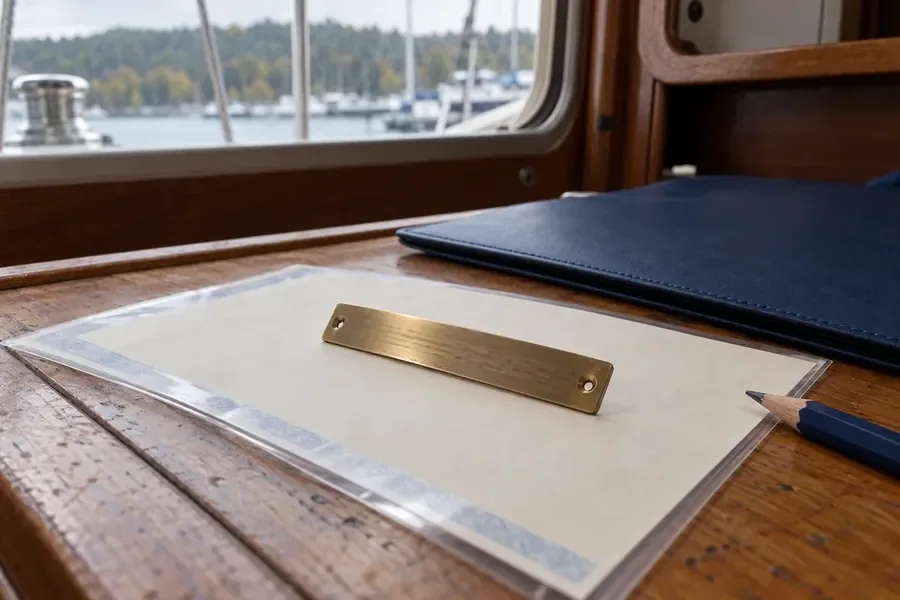
- a six-digit registration number, the “Official Number,” engraved on a metal plate permanently fixed inside the vessel;
- a category, that is, a classification: pleasure, fishing, passengers, etc.;
- a domicile, the port of registry;
- a legal status that defines it as made up of 64 undivided shares.
The document issued is the Certificate of Registry. It was once called the “Blue Book,” because it looked like a hardcover book with a blue cover. It is now delivered in a semi-transparent blue nylon envelope.
Issuance is handled by Transport Canada in Ottawa, with regional offices, the ports of registry, in every province. The application involves several steps:
- filling out and signing various statutory documents;
- having the applicant’s signature sworn, since it serves as a declaration of Canadian citizenship or permanent residence;
- establishing the chain of title with certainty;
- presenting the original contract of ownership with proof of full payment to the seller;
- paying the required fees.
The owner must be a Canadian citizen, a permanent resident or a legal person incorporated under the laws of Canada or of a province. Trusts are excluded. A boat over 15 metres must also be measured by a tonnage measurer, as must a multihull, a boat with two decks or a boat whose deckhouse takes up more than 70% of its length overall. Finally, the boat must be paid in full before the certificate is issued. The details on citizenship are in our marine note Citizenship: seller and buyer.
Registration also has a concrete advantage at resale: the title search is safer. It usually begins with the “Transcript of Registry,” a document that shows the names of the owners as well as the original amount of the debts and of the other security interests or seizures registered. Selling prices, for their part, remain confidential.
4.
When registration is strongly recommended
All boats can be registered in Canada. Our advisors strongly recommend registration in four situations:
- the craft measures 8 metres (26 feet) or more;
- its value is $50,000 or more;
- it travels outside Canada;
- its owner plans to borrow.
These four situations match the advantages that registration provides.
Travelling more easily. A registered vessel is easy to identify anywhere in the world. The countries that have signed the international Brussels conventions have comparable registration systems, which makes travel and transactions from one country to another easier. Our marine note Registration, Canada and other countries compares these systems.
Financing the boat. The Certificate of Registry is required to register a marine mortgage. You, or a future buyer, will be able to benefit from the low interest rates and the flexible repayment of this type of loan. Our Marine credit page presents the financing products.
Keeping the boat outside Canada. It is registration that allows a Canadian, whether a natural person or a business, to keep their boat outside Canada without paying customs duties, GST or QST in Canada. It is also the only Canadian form of recording possible for a boat kept in bond.
Sharing and passing on ownership. The vessel’s 64 shares can be divided among several owners, and the principle of the “right of survivorship” makes it possible to decide in advance how ownership is transferred upon a death. Our marine note Ownership of a registered vessel explains these choices, which are made at the time of registration.
Every transaction is a special case. Before buying, selling or registering a boat, write to one of our marine advisors or call us at (514) 985-6606, or toll-free at (866) 531-2645.
Related reading
Firm service
Marine note
Marine note
Firm service
Marine note
The ten notes
Blog article
Talk to a marine advisor
Give yourself the best chance: call us!
- Telephone: (514) 985-6606
- Toll-free, Canada and United States: (866) 531-2645
- Write to the office


